
Last verified: September 2026. Entry requirements and fees are subject to change. Review this post before travel and confirm current figures with your tour operator.
Getting into the Galápagos is not complicated, but it has more moving parts than most destinations. There are two fees to pay, two separate biosecurity controls to pass through, and a sequence that needs to happen in a specific order before you board your island-bound flight. Miss a step or underestimate the time involved and you can lose your flight. This post walks through the full process from mainland airport to island arrival, with the current costs, the exact steps, and the things that many travelers get wrong the first time.
There are two fees every international visitor pays to enter the Galápagos, and they are paid at different points in the journey.
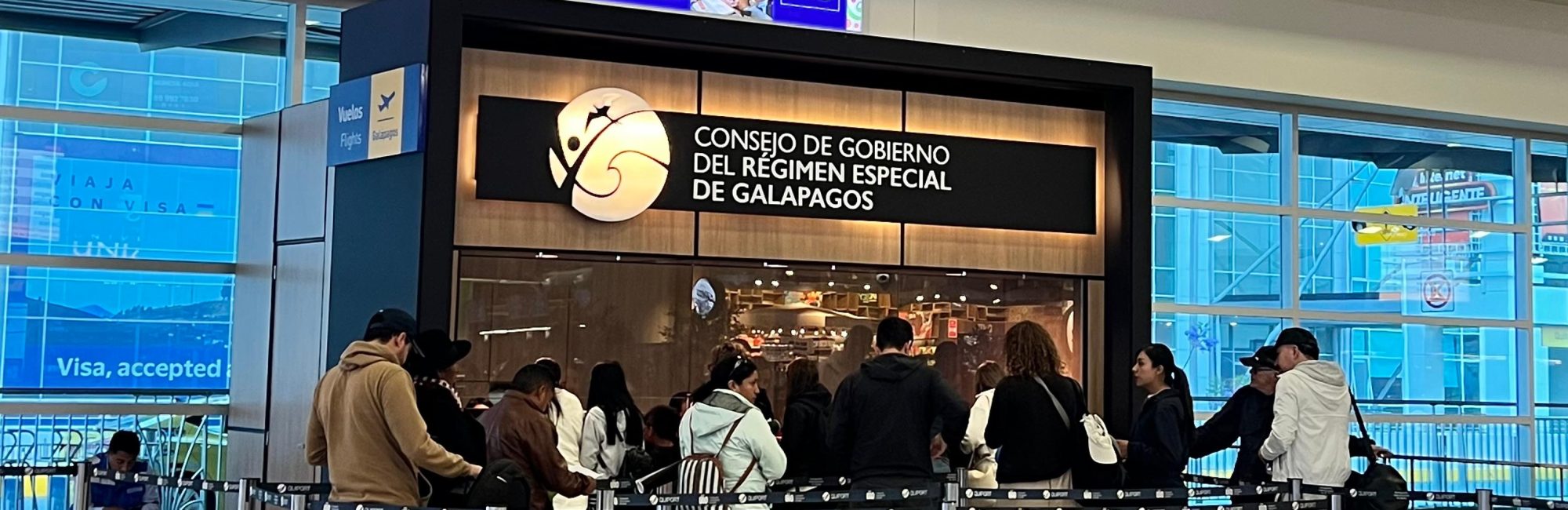
The first is the Transit Control Card (TCT), which costs $20 USD. This is paid before you ever reach the airport, ideally online at the Consejo de Gobierno Website page. The TCT is a migratory control form that registers your transit to the islands and is checked at multiple points: at the Galápagos Government Council bureau in the airport, again at the airline check-in counter, and on arrival. You need it printed or accessible on your phone.
The second is the Galápagos National Park entrance fee, paid in cash on arrival at the island airport. Current rates are:
The TCT website works, but not always smoothly. Travelers regularly report two types of failures: paying successfully but receiving no confirmation email, or the page closing without completing the charge at all.
If you paid and got no confirmation, do not assume the payment failed. You’ll need to approach directly to the Galápagos Government Council bureau at the airport. The staff there can look up your transaction, confirm the payment, and issue your TCT on the spot.
If the page closed and didn’t charge you, your information is likely still in the system as a payment pending. You can complete the payment at the bureau counter directly. Cash is strongly preferred. Some travelers have reported being able to pay by credit card at the counter, but this is not guaranteed and carries a 3.5% surcharge when it is accepted. Bring $20 USD in cash as a backup regardless.
Timing matters here. The bureau gets busy, particularly on Wednesdays, Thursdays, and weekends, when cruise departures concentrate and long lines of travelers are checking in or purchasing their TCT at the last minute. Pay online in advance and leave more time at the airport than you think you need. How much more is covered in the planning section below.
SICGAL is the Galápagos Biosecurity Agency. Its job is to prevent invasive species from reaching the islands, and it operates two checkpoints: one at the departure airport on the mainland, and one on arrival at the island.
Before reaching the SICGAL scanner at your departure airport, you need a completed declaration of goods. This used to be a paper form handed out on the flight. It is now an online form that must be completed in advance at siabg.abgalapagos.gob.ec/declaraciones/nueva.
Complete it at least 24 hours before your flight and download the PDF. The internet connection at Quito’s Mariscal Sucre Airport can be slow, and at peak travel times there are often groups of travelers trying to fill out the form on the spot at the scanner, creating a bottleneck. Downloading the PDF in advance means you walk through without delay.
At the scanner, your checked luggage and carry-on will be tagged and sealed. These tags stay on throughout the flight and are removed by SICGAL staff on arrival at the island. Your personal item, such as a small backpack or purse, does not get tagged.
The biosecurity inspection focuses on anything that could introduce organic material or invasive species to the islands. The items most commonly confiscated are ones travelers carry without thinking twice.
Fresh fruit is the most frequent: bananas, apples, tangerines, and oranges are regularly taken at the scanner. Seeds and grains are also prohibited, including fresh, unroasted coffee beans. Fireworks are prohibited entirely.
The underlying principle is straightforward. Anything alive or capable of carrying living organisms that is not native to the islands is a potential threat to an ecosystem that developed in isolation over millions of years. The inspection is not bureaucratic theater. It is one of the more consequential environmental controls you will pass through as a traveler anywhere in the world.
Packaged and processed food is generally fine. If you are unsure about a specific item, leave it at home or eat it before the scanner. Once your bag is tagged at the mainland checkpoint, it cannot be opened until SICGAL removes the tag on arrival.
Here is the full sequence, from when you arrive at your departure airport to when you walk out of arrivals on the island.
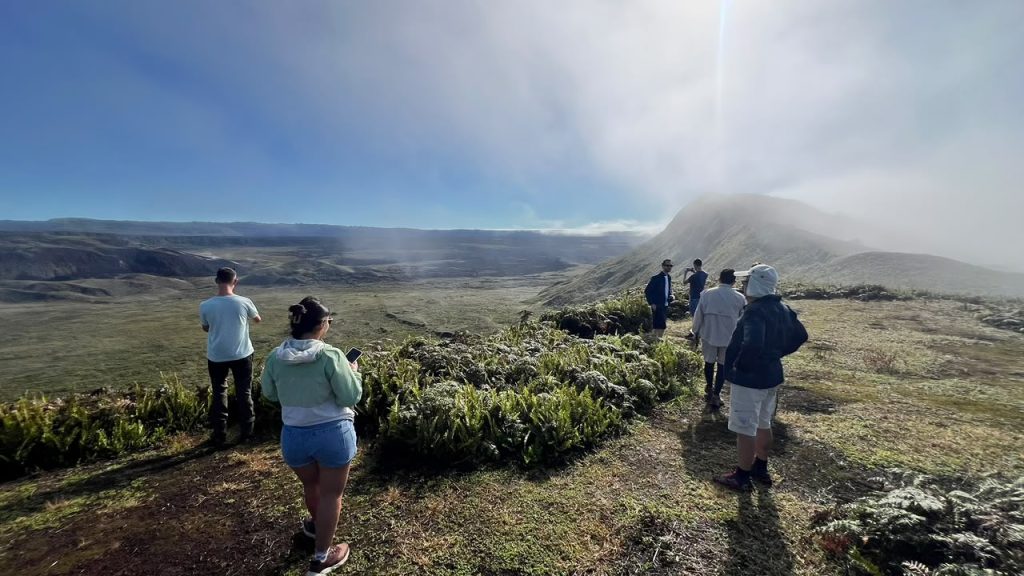
The Galápagos National Park published updated visitor regulations in September 2026, formalized under the title “Reglas generales de visita y normas de comportamiento aplicables en el parque nacional Galápagos y la reserva marina de Galápagos” and recorded in the Registro Oficial. These apply to all visitors, guides, and operators without exception.
Guided visits are mandatory in protected areas. All visits must be accompanied by a naturalist guide accredited and authorized by the Dirección del Parque Nacional Galápagos (DPNG), unless a specific site has been expressly designated as not requiring one.
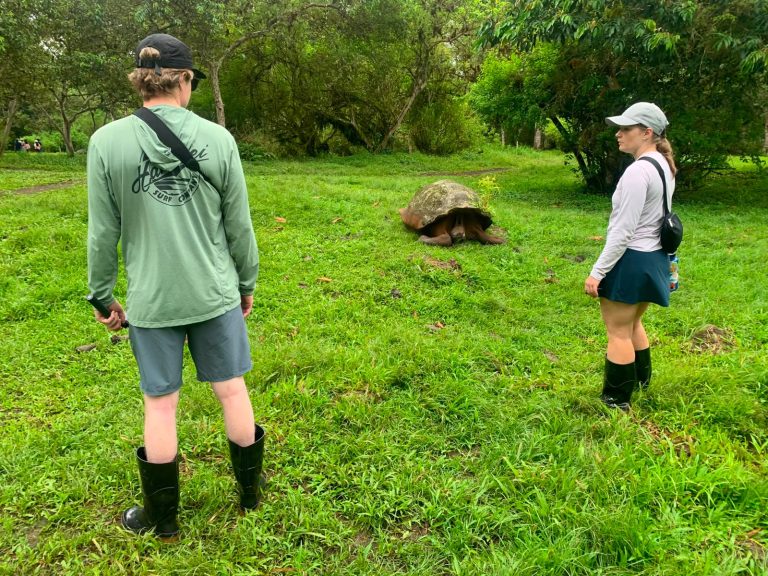
Wildlife distances are legal minimums, not suggestions. This is the rule most consistently underestimated, and the one that has resulted in fines for both operators and individuals. The current regulations are specific:
No touching, feeding, or interfering with wildlife. This covers nesting, resting, and feeding sites. If an animal blocks a trail, wait at the required distance. The regulations specifically address this scenario: you may only go around an obstruction when continuing along the trail is genuinely impossible, and you must return to the designated path immediately.
No flash photography near wildlife. Professional filming equipment, drones, professional underwater cameras, and remote camera systems all require prior authorization from the DPNG. The updated regulations go further than previous versions: material obtained without authorization cannot be published or shared online, and published unauthorized content can be used as evidence in administrative proceedings.
Stay on designated trails. Do not damage, alter, or use infrastructure in ways other than its intended purpose.
Run through this list in the days before you travel.
The Galápagos rewards preparation more than almost any destination. The entry process is manageable — but only if you treat each step as fixed, not flexible.
A couple traveling with us in late 2025 arrived at the airport with an hour and a half before their flight. That felt like enough time. They spent close to an hour in the Galápagos Government Council bureau queue. Their flight closed while they were still in line. Because it was a busy travel week, the next available seat was not for two days. They lost two days of their itinerary and paid for replacement flights out of pocket. The bureau line was the only reason.
The fees are straightforward, the forms are online, and the rules are clear. What catches people is the timing, and the timing is entirely within your control before you leave for the airport.
Three hours minimum before your flight. Cash for the park fee in your wallet before you land. The SICGAL declaration downloaded the day before. Do those three things and the process works the way it should.

